
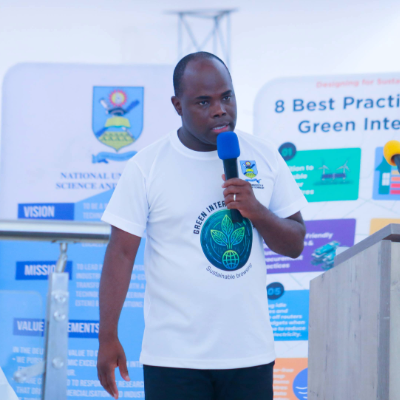
BULAWAYO – The National University of Science and Technology (NUST) is charging ahead in addressing the environmental impact of the internet and its digital infrastructure, by spearheading the nation's "Green Internet Revolution."
The latest initiative, a high-level Green Internet Seminar hosted by the Department of Informatics and Analytics in the Faculty of Applied Sciences at the NUST Ceremonial Hall on Wednesday, December 10, drew staff and students from key departments including Informatics, Computer Science, Electronics, and Engineering.
The seminar served as a crucial platform to raise awareness of practices aimed at minimising the ecological footprint of the internet and its supporting technologies. Green Internet is defined by the project as a move toward designing and promoting environmentally friendly digital choices.
The project, which began in 2023 and is slated for completion in January of 2026, is a collaborative effort between NUST and the Environmental Management Agency (EMA), funded by the Internet Society Foundation.
Key topics addressed during the seminar include; Electronic Waste Management, Green Network Design, Green Computing Principles, The Role of Renewable Energy in IT, Digitalizing Energy Education
The project has already made significant contributions, launching and delivering research findings on internet waste to the Ministry of Information Communication Technology earlier this year. This culminated in a high-level research findings workshop in Harare titled, "Towards a Green Internet Ecosystems Framework for Zimbabwe."
In his speech, read at the research findings seminar, NUST Vice-Chancellor, Professor Mqhele Dlodlo, underscored the university’s pride in leading the initiative. "The project demonstrates the power of academic research in addressing national challenges," Professor Dlodlo stated, emphasizing NUST's commitment to collaborating with government officials, academics, civil society, and industry leaders to develop real-world solutions.
Addressing seminar participants at the Ceremonial Hall, speaker and lecturer, Mr Smart Ncube, the Team Leader of the Internet Society (ISOC)-funded Greening the Internet project, urged participants to minimize both ecological disturbance and electricity consumption.
"The aim is to say when you do your internet activities, you can try and minimize disturbance to the ecology," Mr. Ncube said. "Apart from disturbing the ecology, you can minimize the consumption of electricity. Let us try to adopt using electricity with alternative sources."
Mr. Ncube further stressed the critical role of students and staff as future decision-makers and innovators, highlighting the project’s alignment with Education 5.0, which drives NUST's mandate for research, innovation, and industrialization.
Dr Sibonile Moyo, also a lecturer in the Department of Informatics and Analytics, advocated for the responsible use of computing systems, focusing on the entire lifecycle, designing, developing, and disposing of technology in an environmentally friendly manner. "We advocate for responsible use of our computing systems. There is a lot of electronic-waste associated with computing systems," Dr. Moyo noted, pushing for energy-efficient software design, low-power devices, and effective power management practices.
Adding to the discussion, NUST Lecturer, Mr. Israel Dabengwa, focused on the lack of public knowledge regarding IT policy and responsible disposal methods. He encouraged practical measures such as sustainable data consumption (streaming instead of downloading), unplugging devices, and power management like turning off mobile phones to reduce energy use. "The benefits of going green is that they reduce electricity consumption and create opportunities like green jobs," Mr. Dabengwa explained, challenging attendees to be champions of green energy within their organizations.
The adoption of renewable energy was strongly supported by Lecturer Engineer Samson Mhlanga, representing both the SOLTRAIN and EU-ZW projects, who emphasized that these technologies directly support the development of more energy-efficient and sustainable internet systems.
The seminar concluded with a forward-looking plan to establish a Green Computing Club at the university, solidifying NUST’s ongoing commitment to fulfilling the Education 5.0 mandate by tackling environmental challenges through research and innovation.